
Uncertainty as Fermentation
When the conditions changed, the fermentation started working

This essay was originally commissioned by TORCH and published in Recorded Flesh Voice. The English edition is available here; the Japanese print edition here. Special thanks to Kazuya Sano for the invitation.
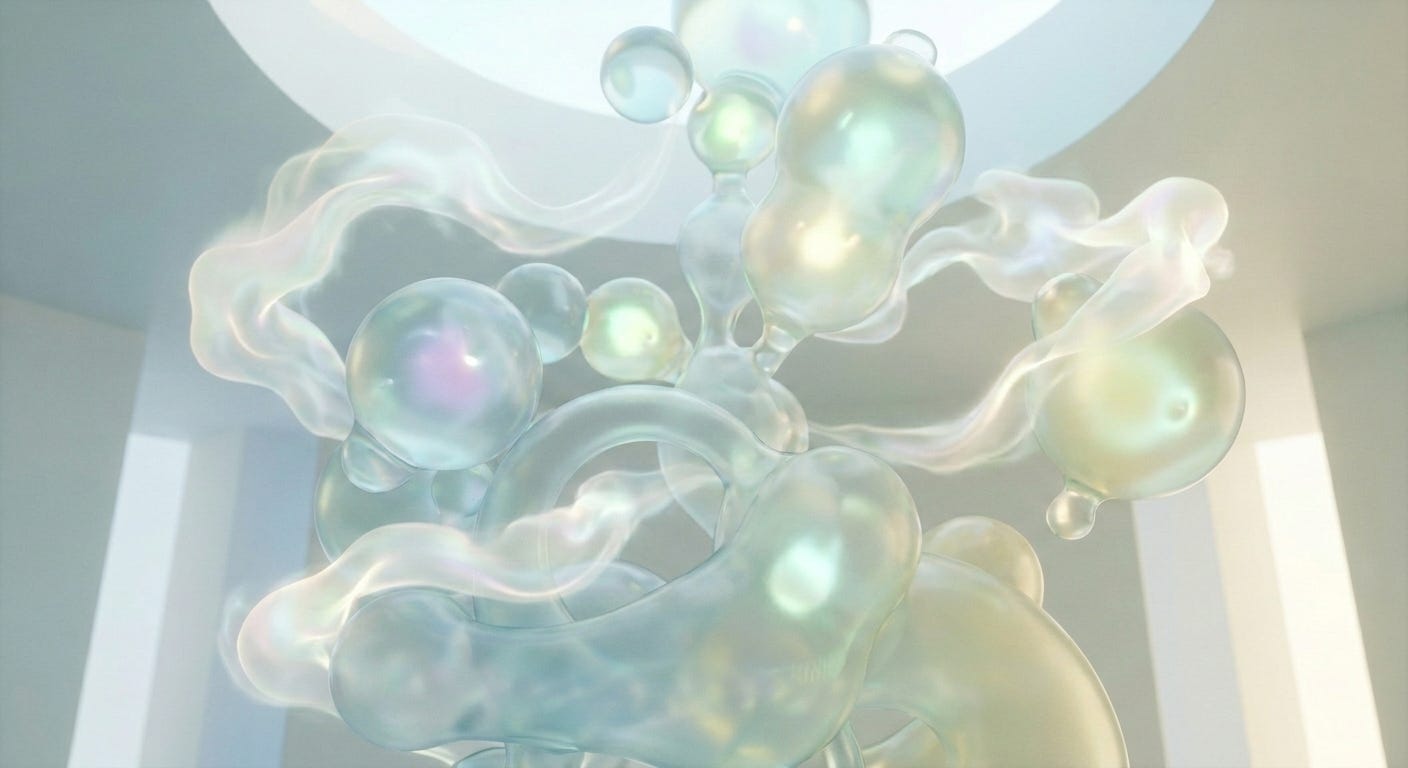
There is a word in Japanese 醸す that means both to brew and to let something emerge naturally over time. The outcome is never quite what you planned, but usually more surprising than expected. I encountered this concept years ago and held onto it, because it named something I had been living but could not articulate: the feeling of things falling into place, not because I designed them to, but because everything I had accumulated over the years was quietly fermenting, waiting for conditions that did not yet exist.
Over the past decade, I’ve worked across tech companies, cultural institutions, luxury brands, retail, and research labs, moving between product design, foresight, digital art, and creative production. The projects varied widely, from immersive experiences and brand activations to future research and design innovation. But the hardest problem was always the same: getting people aligned on a creative direction before anything gets made. In most cases, execution wasn’t the hard part. Figuring out the direction was.
That problem did not go away when AI arrived. It got sharper. When anyone can generate images, prototypes, and narratives in minutes, the question of what to make and why becomes the only thing that matters. Execution is approaching zero cost. Direction is the new scarcity, and the discipline I had spent years inside, speculative design, had always been a practice of direction.
For a long time, speculative design and design fiction were positioned primarily as art practices, provocative objects in galleries meant to be observed from a distance. That positioning always misread what speculation actually is. At its core, it is a cognitive tool: a way of thinking that trains us to simulate alternate realities, test the resilience of our assumptions, and practice radical imagination before committing to a path. A learnable, transferable methodology for asking better questions, sitting with uncertainty, and moving from signal to direction.
I had spent years building that way of thinking into my own practice. Speculative design taught me to ask “what if”. Foresight taught me to read signals. Architecture taught me to think in systems. Engineering taught me to ground ideas in reality. Working across China, Japan, and the United States helped me find that the same problem looks completely different depending on where you stand. None of these felt like skills I possessed. They felt like structures I had become. And for years, I tried to share them through talks, workshops, and finished projects. Audiences found the approach fascinating, but they could rarely take the mental model back to their own practices. The methodology stayed in the room where it was demonstrated.
Then AI collapsed the distance between thinking and making. For a practice built on imagination, lifting the production ceiling meant something specific: the thinking itself could finally be systematized, which made reusable, extended beyond any single practitioner’s bandwidth or any single collaboration. I did not set out to build new systems and tools. It simply unfolded.
The first to take shape was Actual Future. Scanning for weak signals and analyzing emerging patterns was always the most labor-intensive part of the process, done manually, filtered through intuition, limited by how much any one person can reasonably track. AI took that burden off. It now handles the search and analysis according to my own criteria, releasing the process from its dependence on my bandwidth. What remains is the part that requires judgment: identifying which trajectories matter, and envisioning what they might become. The act of asking “what if” has moved from a rare workshop exercise into a continuous daily practice.
Actual Fiction Lab grew from another perspective, one rooted in the nature of world-building itself. Every element in a speculative world connects to another, and that web of associations expands far faster than a single human mind can track. When I worked purely from my own imagination, the worlds I built were only as expansive as my ability to hold their internal logic together, which meant they were always smaller than I intended. AI became the collaborative partner that expanded what was possible, stress-testing the consistency of the world, surfacing connections I would have missed, sustaining the complexity of the narrative at a scale that would have otherwise been impossible.
Together, they form something I had been circling for years: AI-native creative systems that operate upstream, where direction is formed.
Looking back at how these tools came to exist, I keep returning to the same word: fermentation. Rather than invention, you do not design the outcome in fermentation. You prepare the ingredients, your experiences, your accumulated ways of seeing, and you create the conditions for transformation. A new technology, a shifting landscape, a moment when the old frameworks stop fitting. You place what you have into that environment, you stay attentive, and you let it become what it will.
The art and technology field is in a fermentation phase right now. The old operating system ran on novelty: new media, new interfaces, new spectacles. Each wave of technology powered a cycle of fascination and fatigue. But novelty is now infinite. AI generates endless variations of anything. When novelty is no longer scarce, what becomes valuable is the capacity for sustained creative judgment. And that capacity cannot be replaced. It is a way of seeing over years, through practice, failure, cross-disciplinary collision, and the slow accumulation of ways to understand the world. It is what you have become, not what you know how to do.
The detours, the disciplines, the disorientation of moving between worlds, all of it has been reshaping who you are and how you perceive. These are the raw material for your ongoing fermentation, not credentials on a resume. When the conditions change, the question is whether it can find new forms.
Trust what you have accumulated. Stay in the practice. Let it grow into what it will.
Qinqin (Stella) Yang (qinqinang.com) is a creative director and strategist working at the intersection of AI capability and creative practice, focusing on expanding what’s even perceived as possible. She founded Actual Fiction and has been dedicated to developing AI-native creative systems and tools for signal sensing, early direction finding and world-building. Previous clients include IKEA SPACE10, Tencent, the Palace Museum, and LVMH etc. She has been recognized by Fast Company Innovation by Design, Core77, The Lumin Prize, and WIRED Japan, and holds a bachelor’s degree in Electrical Engineering from UCLA and an MFA in Design and Technology from Parsons School of Design.