


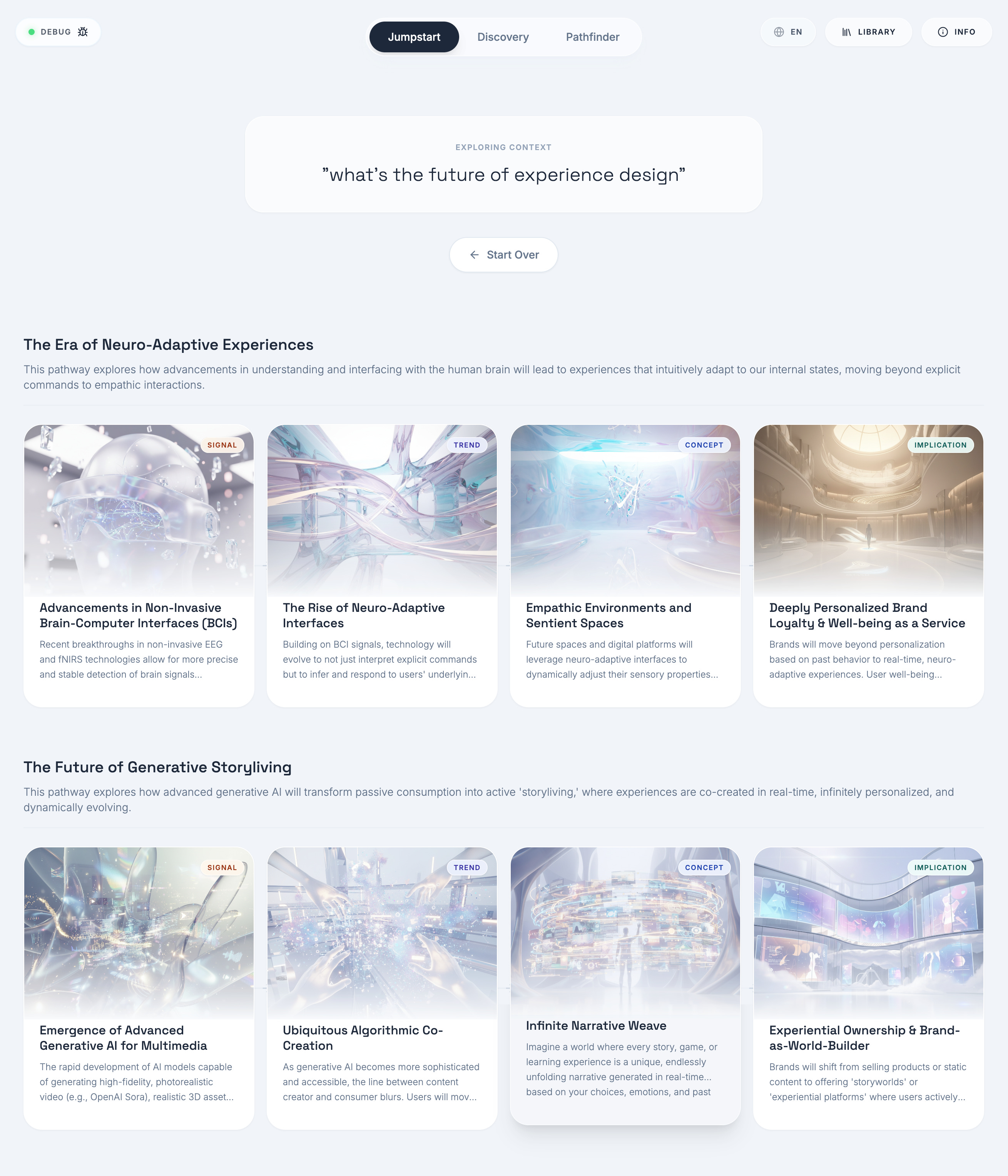
Recently, while spending time with AF-OS I’ve been building and using to explore possible future realities, the idea of the future of generative storyliving especially caught my interest and prompted me to dive deeper.
What caught my attention wasn’t the novelty of the term, but the quiet tension it seemed to surface. The more I thought about it, the more it began to feel less like a speculative idea and more like a response to something already misaligned in how experiences are designed and consumed today. I wanted to go beyond the summary AF-OS had surfaced and spend time reflecting on what this direction was actually pointing toward, and why it felt so persistent.
That reflection kept leading me back to a familiar discomfort. Many of the experiences I engage with now are exceptionally good at capturing my attention. They are polished, immersive, emotionally articulate. They do exactly what they are designed to do. And yet, when I look back over time, very few of them stay with me in any meaningful way. They resolve cleanly. They conclude. They release me back into the stream, leaving behind little more than the memory of having completed them.
For a long time, storytelling has shaped the dominant logic of experience design. Experiences are structured to move forward, to build tension, to arrive somewhere. They ask for focus, reward engagement, and signal success through completion. In a landscape increasingly defined by abundance and competition, this logic has been extraordinarily effective. But it has also quietly trained us to accept experiences as momentary performances rather than ongoing presences.
It’s here that the broader conversation around attention begins to make sense, not as a starting point, but as a symptom. In Stolen Focus, Johann Hari describes distraction as something shaped less by individual weakness and more by environments that turn experience into moments designed to be captured and left behind. What this framing reveals is not only why attention feels strained, but what kind of experiences we are repeatedly being offered: experiences optimized to be entered, consumed, and exited with minimal friction.
Many things succeed in capturing our attention. Far fewer are designed to remain with us.
When experiences are built to peak and conclude efficiently, continuity becomes incidental. Memory becomes recall rather than relationship. The problem, then, is not that attention is scarce, but that experience itself has been shaped around its capture, rather than its ability to accompany a life over time.
Storytelling taught us how to follow, not how to remain
For decades, storytelling has provided the dominant grammar for experience design. Stories move forward. They organize time into arcs. They promise resolution, even when that resolution is ambiguous. This narrative logic has shaped far more than books and films. It underpins exhibitions, digital products, campaigns, interfaces, and interactive media. An experience begins, unfolds, and ends. Meaning is delivered through progression.
This model has been extraordinarily effective. Storytelling gives designers control over pacing, emotion, and interpretation. It creates coherence in environments crowded with competing signals. But it also carries an assumption that often goes unquestioned: that an experience succeeds once it has been consumed.
Life rarely works this way. Meaning does not arrive on schedule. It accumulates unevenly. It changes shape depending on when we return to something, what else has happened in the meantime, and what we now notice that we didn’t before. The experiences that shape us most are often not the most intense or dramatic ones, but the ones that remain partially unresolved.
Guy Debord described a version of this tension long ago in The Society of the Spectacle, when he observed how modern life increasingly replaces lived experience with representation. Experiences become things we watch, consume, and move past, rather than conditions we inhabit. Storytelling, for all its power, often participates in this logic by prioritizing representation over duration.
When experience stops performing and starts coexisting
I began asking myself a different question: What happens when we stop assuming that experiences need to perform in order to matter?
What if an experience doesn’t aim for narrative payoff or emotional climax, but instead makes room for time, absence, and return? What if it isn’t designed to hold attention, but to earn a place alongside someone’s life?
This is where my thinking has begun to shift from storytelling toward what I’ve been calling storyliving. Not as a finished concept, and certainly not as a new genre, but as a way of naming a different orientation toward experience.
Storyliving reframes experience around presence rather than progression. Instead of asking someone to follow a plot, it asks them to occupy a position. Instead of delivering meaning, it allows meaning to form gradually through proximity, repetition, and change. Time is no longer something to be optimized or compressed. Time is what gives the experience its weight.
Everyday life was never a story
One reason storyliving feels intuitively compelling is that it aligns more closely with how everyday life actually unfolds. Michel de Certeau wrote in The Practice of Everyday Life about meaning as something produced through repetition, improvisation, and small acts that resist formal structure. Life, in this sense, is not lived as a narrative arc, but as an accumulation of moments whose significance often becomes visible only in retrospect.
Experiences designed for storyliving borrow from this logic. They do not rush toward explanation or closure. They assume people will leave and return. They accept that absence is part of participation. What matters is not whether someone sees everything, but whether the experience is capable of holding memory, history, and change.
This is a fundamentally different demand on experience design. It asks designers to let go of the desire for immediate legibility and control. It requires accepting that meaning may not be evenly distributed, and that different participants will carry different versions of the same experience depending on where they enter and how long they stay.
What stays with us is rarely what was most optimized.
Generative systems as conditions rather than content
Much of today’s work in generative storytelling still extends the assumptions of traditional narrative. Systems generate plots, dialogue, scenes, or branching paths. Interaction is framed as choice, and choice is framed as agency. These approaches are technically impressive, but they rarely challenge the underlying structure of storytelling itself.
Storyliving suggests a different role for generative systems. Rather than generating events, they could generate conditions. Rather than producing content, they could sustain a world, a situation, or a set of relationships that continue to exist regardless of whether anyone is paying attention at a given moment.
Recent discussions around AI and culture have emphasized that intelligence is not only about output, but about maintaining context, memory, and coherence over time. This perspective opens up a different horizon for generative experience design. One in which generation supports continuity rather than novelty, and presence rather than performance.
Toward experiences that are allowed to remain open-ended
I don’t see storyliving as a rejection of storytelling. Stories will always matter. They help us make sense of complexity and give shape to chaos. But alongside them, there may be room for experiences that operate by different rules. Experiences that are not designed to be consumed or resolved, but to be lived with over time, in ways that remain open to interruption, return, and change.
As generative systems make it easier to produce content at scale, the value of experience may begin to shift. Less toward novelty, intensity, or immediacy, and more toward duration and continuity. Not everything needs to explain itself. Not everything needs to arrive at a conclusion. Some experiences matter precisely because they are allowed to unfold slowly, accumulating meaning without insisting on closure.
This is the direction I’ve begun to explore more concretely. Moving beyond concepts, I’m looking at how generative storyliving might take shape in practice: how experiences could persist without demanding constant engagement, how they might evolve over time, and how they could remain present without needing to perform. These explorations won’t appear all at once, and they aren’t meant to resolve neatly.
After attention is captured, the question is what if anything continues to live alongside us.
I’ll be sharing this work as it develops, as a series of thoughts, experiments, and partial understandings rather than finished answers. If this line of inquiry resonates with you, I’d love to continue the conversation.