


This is Part 2 of The Creative Infrastructure, a series on workflows, frameworks, and philosophy for the AI era. In Part 1, we examined the smoothness problem. AI era abundance shifts scarcity away from production capacity and toward judgment. This essay moves from diagnosis to structure.
The Productivity Paradox: When “Doing” Hits Zero
An old equation needs to be retired. Labor time once functioned as a proxy for value.
In the pre AI paradigm, effort carried meaning. Hours spent signaled seriousness, difficulty, and scarcity. As AI collapses the marginal cost of production, finishing the work no longer proves anything. Completion has become easy.
Quality standards therefore require reconstruction.
The previous standard focused on completion. The emerging standard centers on depth of insight and the clarity of intent guiding the work. When AI absorbs most execution pressure, expectations for the final artifact increase. A merely workable product carries little significance. It becomes polished noise.
When execution stops functioning as the primary bottleneck, direction moves into that role.
The Intent Gap: Why We Are Focusing on the Wrong Phase
Most AI tools concentrate on the production phase. Their design optimizes the how and increases throughput. Higher throughput offers limited leverage when the destination remains vague. Acceleration often leads toward an unclear outcome more quickly.
The structural scarcity of the AI era lies in intent and framing.
Intent often appears in our imagination as a clear object waiting to be expressed. In practice it behaves very differently. Intent begins as a blur. It might appear as faint discomfort, a half shaped curiosity, or a weak signal that still lacks language. Many times the desired direction only becomes visible once a process allows it to surface.
Production becomes abundant. Intent discovery becomes the premium phase.
Yet this stage rarely receives structural support because it unfolds slowly and quietly. It does not produce artifacts that can be shipped.
AI as a Thinking Partner: The Mirror That Clarifies
Here is where AI can offer its most meaningful value: not as a generator of final outputs, but as a guide during intent discovery.
Used carefully, AI can function as a Socratic partner. It reflects emerging ideas, helps consolidate scattered thoughts, exposes hidden assumptions, and pressures framing until the underlying shape becomes visible. The purpose is to externalize thinking so the structure of one’s reasoning becomes easier to examine.
This introduces a central design question.
How should interaction be structured so AI helps clarify the initial spark without replacing the human voice behind it?
When judgment disappears during the intent stage, efficiency gains disappear as well. The result becomes a high resolution form of slop. Outputs appear polished while resting on an algorithmic center that lacks human stakes.
Structure acts as the dam. Without structure, amplification simply magnifies emptiness.
The Hourglass Workflow: Scaling the One Instead of the Zero
A linear workflow assumes production carries the greatest difficulty. That assumption breaks in the AI era.
A more useful structure resembles an hourglass. Intent receives the heaviest investment at the beginning. Generation becomes light and fast in the middle. Human curation returns at the end.
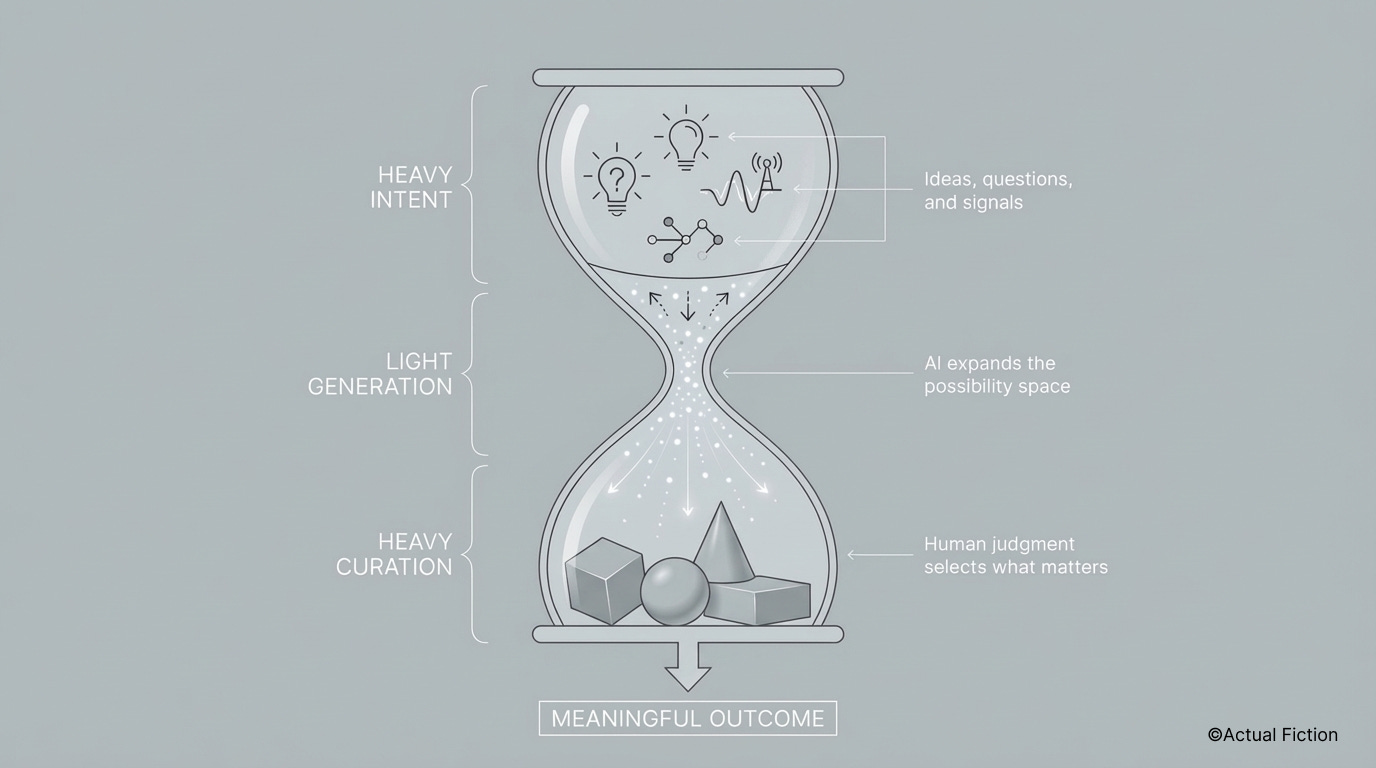
Heavy Intent (Top)
Energy concentrates before the first output appears.
This stage goes beyond prompt writing. The task involves defining the architecture of the work. What tension requires resolution? Which human situation deserves attention? What constraints matter? Which aesthetic direction will guide decisions? What elements should be excluded?
Intent behaves less like a sentence and more like a set of commitments.
Light Generation (Middle)
AI can then expand rapidly.
This stage should remain inexpensive, high variance, and disposable. Generation maps the possibility space and tests the strength of the frame.
Heavy Curation and Texture (Bottom)
Human attention returns during selection and refusal.
This stage separates workable outcomes from meaningful ones. The final one percent begins to appear here. Texture emerges through judgment. It reflects the decisions taken, the edges preserved, and the frictions intentionally left intact.
Within this structure, AI scales volume. Humans scale intent.
Management 2.0: Evaluating the Quality of Refusal
This shift transforms management.
Traditional systems reward visible output. Teams are measured by what ships and what finishes. In an AI integrated environment, finishing becomes baseline behavior. Volume alone reveals little about value.
The new metric is judgment quality — and the most legible signal of judgment is refusal.
What did you reject, and why?
Did you identify smooth mediocrity early, or did you polish it into something convincing?
Did you protect the frame when the generator offered easy shortcuts?
Did you fight for the texture that makes the work useful rather than merely coherent?
This transition marks the rise of the architect creator. AI handles infrastructure. Humans determine stakes. The work shifts toward better decisions rather than higher output.
Designing the Amplifier
A subtle risk appears here.
Humans may gradually become editors of AI generated material. Their role shifts toward refining outputs whose underlying logic they did not establish. This workflow can feel productive while slowly weakening the only scarce asset: the structure of human judgment.
The pressing task is designing new interaction structures, personal workflows, and management philosophies.
AI can absorb smooth and repetitive logic. Human attention can return to friction filled decisions. These decisions determine what matters, what deserves to exist, and what should disappear.
The winners of this era will not emerge from faster generation. They will come from stronger framing. Freed from execution pressure, they can raise the standard of texture in the work.
Become the architect rather than the patch. Use AI to surface intent and develop thought, while preserving human authority over the spirit of the work.
Architects still require systems.
Recognizing the importance of judgment differs from protecting it structurally. The hourglass shows where the weight should sit. It does not explain how to design the specific moments inside the workflow where insight appears.
Part 3 explores that question.
About the author
Qinqin (Stella) Yang is a creative director and strategist working at the intersection of innovation, technology, and futures thinking. Over the past decade she has built brand experiences, product design and speculative projects for Tencent, IKEA SPACE10, Burberry, and the Palace Museum etc. More recently she has been building AI-native systems through her practice, Actual Fiction, to help creative teams move from ambiguity to clarity.
This newsletter is where she thinks out loud about creativity, innovation and what it means to build towards a future that doesn’t exist yet.
For more details: qinqinyang.com