


A new environment for creative work
Over the past year, most conversations around AI and creativity have focused on tools, speed, and productivity.
But working inside AI-native creative processes revealed a deeper shift.
Creativity no longer lives inside isolated acts or individual moments of inspiration. It increasingly operates inside larger structures: systems for sensing change, forming judgment, and composing meaning across complexity.
At the same time, the human role inside these systems has begun to shift.
As intelligence becomes more distributed, human value moves away from generation and toward direction, judgment, choice, meaning-making, and system-building.
Together, these shifts point toward an emerging reality:
Creativity is becoming a system-level practice, not a one-off moment inside a single project.
But what would a real, working creative system look like?
This is the context in which Actual Future OS emerged.
AF-OS is an AI-native creative operating system that combines structured sensing, human judgment, and deliberate reframing to help individuals and teams move from signals to direction.
A way to translate theory into a working engine.
A glimpse of what scalable imagination looks like in practice.
Why we need a Creative Operating System
The center of creative work has been quietly moving. We are entering an era where creativity requires systems in order to be sustained. Without them, creative practice risks being overwhelmed by AI generation or reduced to whatever moves fastest under the logic of efficiency.
At the same time, tools have become more capable, workflows more automated, and signals now travel faster across culture, technology, and behavior. AI has shifted from a peripheral assistant into a persistent cognitive layer surrounding creative work. The result is not simplification, but expansion.
We now operate inside environments where:
information density grows faster than attention
shifts accelerate faster than intuition can track
problems span multiple disciplines at once
AI continuously increases the range of what is possible
The creative process itself has not broken, but its foundation has changed. Ideas no longer emerge from a single moment of insight. They emerge from navigating an expanding field of signals, tensions, and possibilities. As this field grows, another structural shift has taken place: creative cycles have collapsed. The familiar rhythm of brief, concept, and output no longer maps cleanly onto reality. Creative work now resembles a continuous loop of sensing, shaping, composing, and prototyping. It is less like finishing a poster and more like steering a ship in moving weather.
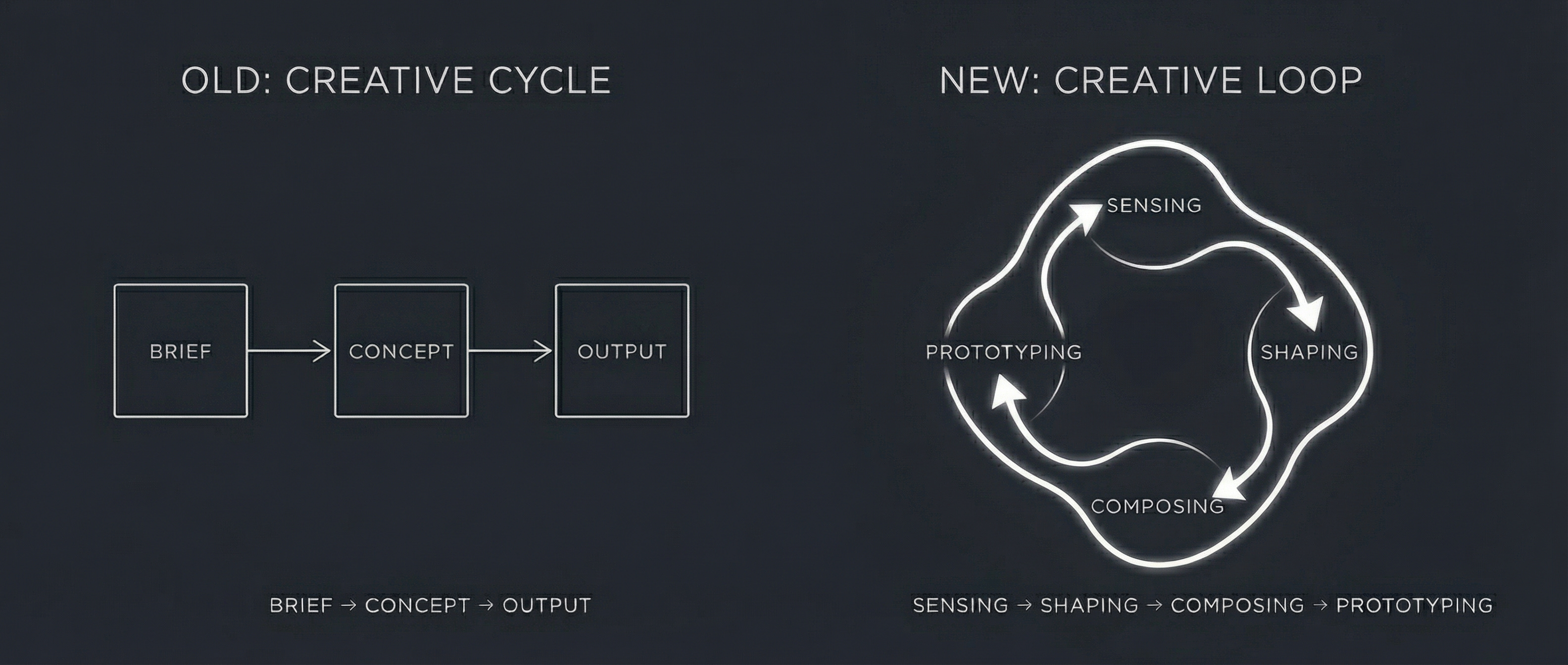
The teams that thrive in this environment are not the ones that move fastest, but the ones that can move through this loop with clarity. Most teams can execute. Very few can continuously produce new direction, new meaning, and new narratives in an environment that never stabilizes. The core challenge of creative work today is not idea generation, but orientation: staying aligned inside a landscape that produces too many ideas, too many signals, and too many possible paths at once.
This is why creative work now needs a different kind of structure. One that can hold complexity without collapsing, while enabling stable direction, coherent meaning, structured exploration, and strategy inside uncertainty. This is where the idea of a Creative Operating System becomes essential.
AF-OS: From making outputs to building a creative system
At its core, Actual Future OS is built around a single belief:
Creative work becomes powerful when it becomes structural.
When it stops being “a thing we make” and becomes “a system that continuously generates meaning and possibility.”
To do this, AF-OS organizes creative thinking into four foundational units.
I call them future units: signal, trend, concept, implication.
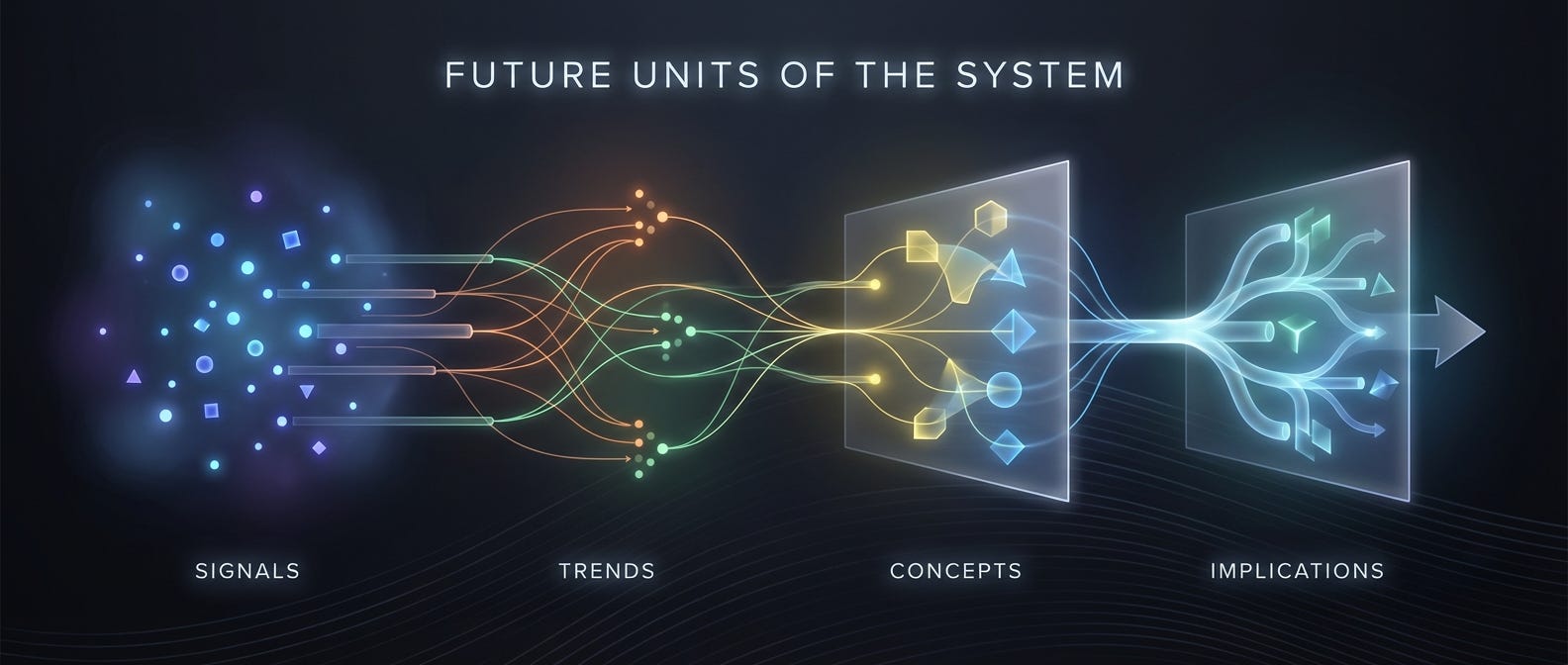
Together, they form the spine of how the OS reads the world and constructs futures.
But these units are not “steps”.
They are layers in a cognitive architecture, each transforming the world in a different way.
Signals: The world as input
Every creative system begins with sensing.
AF-OS collects and organizes signals across technology, culture, science, behavior, and media. But more importantly, it gives signals structure: strength, drivers, STEEP lenses, context.
In an environment full of noise, the OS helps you notice the small shifts that actually matter.
What emerges is not a feed, but a living database of future-relevant change.
Signals become the raw material of imagination.
Trends: Turning fragments into structure
Signals alone don’t create understanding.
The real value comes from seeing how they move together.
The Trend Layer identifies patterns, themes, and tensions — the structural relationships that reveal what is emerging, what is converging, and what is destabilizing. Trends in AF-OS are not predictions and not market categories. They are explanatory structures.
This is where users begin to see the world differently:
not as events, but as systems of forces.
Concepts: The engine of possibility
Once structure appears, imagination can emerge.
The Concept Layer is where AF-OS synthesizes signals, trends, assumptions, and user intent into possible futures. It generates concept directions, worldviews, scenario narratives, strategic framings, and future experience prototypes. It also supports visual prototyping through images and more.
This is the layer where creative intelligence becomes visible —
where direction and meaning emerge from distributed inputs, rather than being forced out of a single moment of inspiration.
Concepts become the system’s way of giving options with logic.
Implications: Turning futures into action
A future only matters if it can move a decision.
The Implication Layer translates concepts into strategic meaning: product opportunities, service experiences, brand narratives, business possibilities, risks, ethical considerations, and capability requirements.
This layer closes the loop.
It connects imagination with decision-making.
AF-OS is therefore not a tool or a thought experiment.
It is a creative-strategic operating system that moves from “what’s changing” to “what it means” to “what we can do”.
The Vision of Actual Future OS: Make Futures Operable
At its heart, AF-OS is built around a simple idea:
Futures shouldn’t stay abstract.
They should become something we can work with.
Most “futures thinking” lives in speculation, inspiration, or metaphor. AF-OS turns it into a practice that is structural, navigable, and operable.
Its purpose is not acceleration, but clarity —
a way to help creators produce work that is more grounded, more original, and more meaningfully connected to the forces shaping the world.
It is ultimately a system designed to extend the reach of human Creative Intelligence.
The architecture of AF-OS
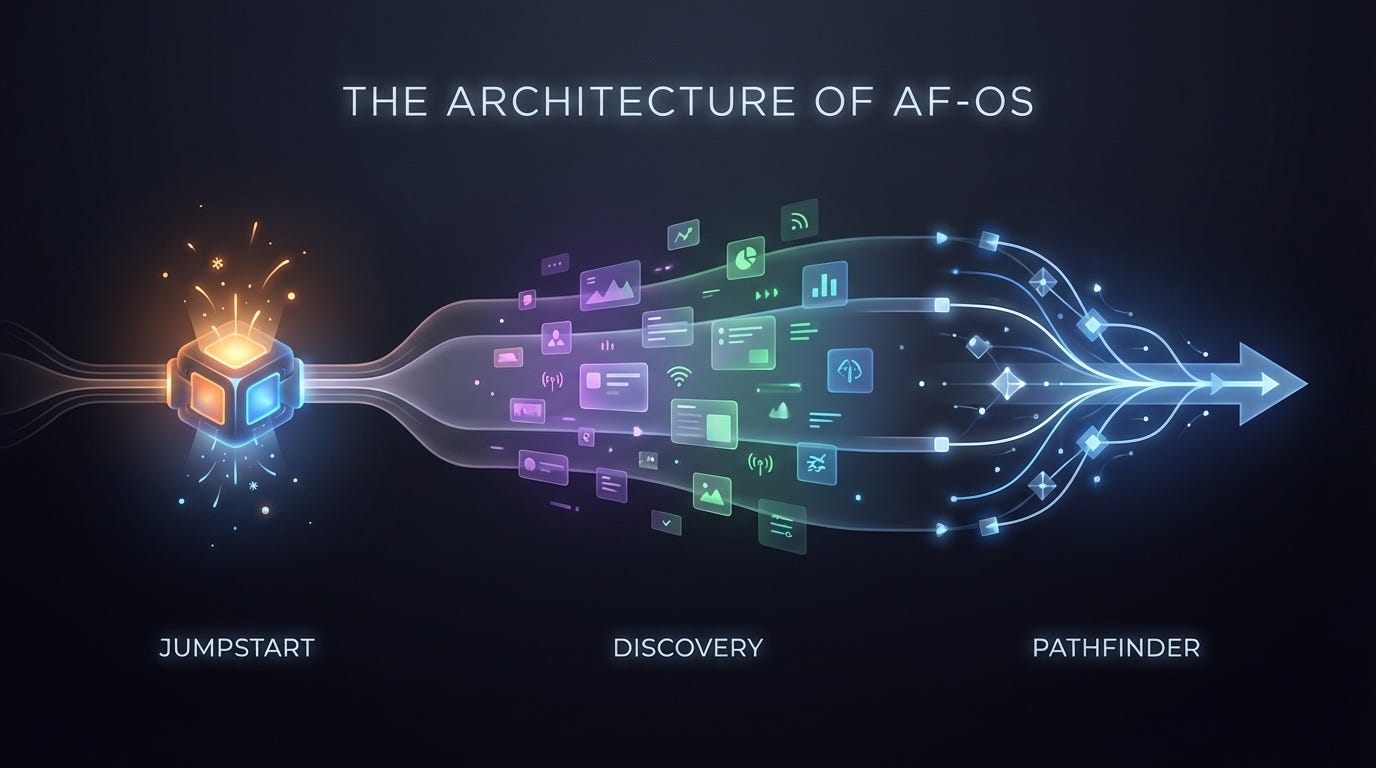
Actual Future OS is structured around three modes. Each mode represents a different cognitive shift, from sparking, to expanding, to forming direction.
Together, they create a complete arc for system-level creative work.
1. Jumpstart
Jumpstart is the ignition point.
It gives users a fast way to enter the space of possibility.
You can drop in anything: a prompt, a link, a half-formed idea — and Jumpstart runs a fast, structured chain: it searches for edge-case signals around the question, synthesizes them into early patterns, and pushes those patterns forward into speculative concepts and implications.
In seconds, a vague prompt becomes a set of grounded possibilities. Not through analysis or prediction, but by activating the space around the question and creating momentum.
Jumpstart is the moment the system turns on and imagination begins to move.
2. Discovery
Discovery opens the landscape.
It is a curated field of possibility — a feed of signals, trends, concepts, and implications that reveal what else is happening across domains.
Each item is its own set, a doorway into a different direction.
You can browse randomly, follow your curiosity, or drift across levels of abstraction.
The goal isn’t to build a map, but to surface new terrain and broaden the field of possibility.
Discovery is the OS’s expanding field of options.
3. Pathfinder
Pathfinder takes the expanded landscape and begins to shape it into direction.
It identifies the throughlines that matter and assembles the elements into a coherent strategy or creative proposal.
This is where Creative Intelligence becomes active,
where judgment filters noise, choice defines orientation, and meaning-making turns scattered possibilities into a structured direction of travel.
Pathfinder doesn’t select ideas, it builds logic.
It outlines the strategic spine, clarifies the core tensions, and constructs the conceptual architecture that guides what comes next.
Pathfinder is the shift from exploration to formation,
where possibility becomes actionable steps.
Why this matters now
The Shift Becomes Urgent
For years, complexity has been rising gradually. But over the past year, creative work crossed an inflection point. The world now moves faster than our existing workflows and mental models were built to support.
Possibility Outpaces Intuition
AI has expanded the possibility space far beyond what human intuition can comfortably navigate.
The challenge is no longer access to ideas, but orientation — knowing where to begin, what matters, and how to shape direction.
Sensemaking Becomes the Creative Bottleneck
The creative bottleneck has moved upstream:
from execution, to ideation, to sensemaking itself.
We are asked to interpret rapid change, connect distant signals, and move from insight to narrative without losing coherence.
This can no longer rely on intuition alone.
Direction Requires Infrastructure
Creative Intelligence becomes most powerful when it can operate inside a stable cognitive environment.
Without structure, direction is fragile.
Without shared scaffolding, teams fragment.
Without an architecture for imagination, ideas drift instead of accumulate.
A Creative Operating System becomes the foundation that enables clarity and coherence at scale.
Setting the Stage for a New Creative System
This is why AF-OS matters now.
It provides a way to stay centered as possibility expands, to navigate the noise, and to work inside a shared workspace where humans and AI can think together. Because in an AI-native world, the scarce resource isn’t ideas. It’s direction.
If you’re leading a team that’s drowning in signals but struggling to form direction, feel free to reach out. I’m always interested in exchange ideas with people building inside uncertainty.